
According to KPMG’s 2023 SOX Report, companies spent an average of $1.6 million and 11,800 hours annually on SOX compliance programs in 2024. Despite these substantial investments, 70% of executives struggle to explain what SOX actually requires. This disconnect creates significant problems for growing businesses approaching public company status or considering US market entry. The challenge particularly affects companies worldwide seeking access to US capital markets through NYSE or NASDAQ listings, cross-border acquisitions, or establishing US subsidiaries.
Many business leaders discover SOX compliance requirements too late in their growth journey. They face overwhelming regulatory demands without clear guidance on practical implementation. Rushed compliance programs cost significantly more and deliver less protection than properly planned initiatives. This reactive approach leads to control deficiencies, audit findings, and unnecessary consulting expenses that strategic planning could have prevented.
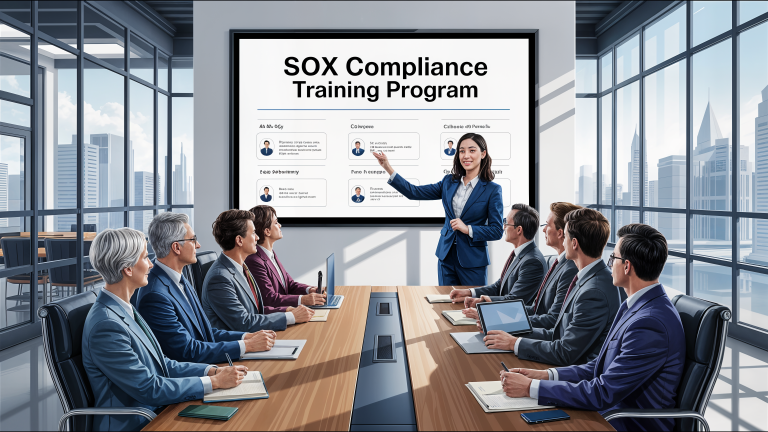
This guide breaks down SOX compliance into manageable, actionable concepts. You’ll understand exactly what SOX requires, who must comply, and how to build effective compliance programs. We cover real-world costs, implementation timelines, and common mistakes that drain resources unnecessarily. Whether you’re preparing for a US IPO, planning cross-border expansion, or managing an existing public company with US operations, these insights help you navigate regulatory requirements confidently. You may also find our SOX Compliance Training Guide insightful for building comprehensive employee training programs.
What is SOX Compliance? (The Simple Definition)
SOX compliance means following the rules established by the Sarbanes-Oxley Act of 2002. This federal law requires publicly traded companies to maintain accurate financial records and implement strong internal controls to prevent fraud.
The law exists to protect investors from corporate financial scandals. It emerged after major accounting frauds at companies like Enron and WorldCom destroyed billions in shareholder value. SOX creates accountability by requiring CEOs and CFOs to personally certify their company’s financial statements
Think of SOX compliance as installing financial system seat belts. Just as seat belts protect passengers during accidents, SOX controls protect investors from financial misstatements and fraud. The law applies to all publicly traded companies in the United States, regardless of size or industry.
SOX compliance centers on two main objectives: accurate financial reporting and fraud prevention. Companies must establish controls that ensure financial data is complete, accurate, and timely. They must also create systems that detect and prevent unauthorized transactions or misstatements.
Non-compliance carries serious consequences. Companies face SEC penalties, stock delisting, and potential criminal charges for executives. The law includes provisions for whistleblower protection and requires companies to establish anonymous reporting systems.
Who Needs SOX Compliance? (Is Your Company Required?)

SOX compliance requirements apply to specific types of companies based on their legal structure and market presence. Understanding these requirements helps businesses plan for compliance obligations before they become mandatory.
Publicly traded US companies represent the primary group subject to SOX requirements. Any company with securities registered under the Securities Exchange Act of 1934 must comply. This includes companies listed on major exchanges like NYSE, NASDAQ, and smaller regional exchanges.
Foreign companies on US exchanges also face SOX compliance obligations. International businesses that list American Depositary Receipts (ADRs) or trade directly on US exchanges must follow the same rules as domestic companies. This requirement often surprises international companies seeking US capital markets access.
Subsidiaries of public companies may need SOX compliance depending on their significance to the parent company. Material subsidiaries that impact consolidated financial statements typically require full compliance. Smaller subsidiaries may need limited compliance measures focused on their contribution to parent company reporting.
Private companies preparing for IPO should begin SOX compliance preparation early. The SEC requires new public companies to comply with most SOX provisions immediately upon going public. Section 404 compliance may be delayed for smaller companies, but other requirements take effect immediately.
When compliance becomes mandatory depends on your company’s status and size. Most SOX provisions apply immediately upon becoming public. However, smaller companies (market cap under $75million) receive additional time to implement Section 404 internal controls requirements.
Common misconceptions about SOX exemptions can create compliance problems. Some companies believe they’re exempt because they’re small or operate in certain industries. However, SOX applies to all public companies regardless of size, industry, or business model.
The key trigger for SOX compliance is securities registration, not company size or revenue. Even small companies with minimal public trading activity must comply once they register securities with the SEC.
The 5 Key SOX Sections Every Beginner Must Know
SOX contains 11 sections, but five sections create the most significant compliance obligations for businesses. Understanding these core requirements helps prioritize compliance efforts and resource allocation.
Section 302: CEO/CFO Certifications requires top executives to personally certify the accuracy of financial statements. CEOs and CFOs must sign quarterly and annual certifications stating they’ve reviewed reports, found no material misstatements, and believe the information fairly presents the company’s financial condition.
These certifications carry personal liability for executives. False certifications can result in criminal penalties including fines up to $1 million and imprisonment up to 10 years. Section 302 also requires executives to certify that they’ve disclosed all significant deficiencies in internal controls to auditors.
Section 404: Internal Controls represents the most expensive and complex SOX requirement. Companies must establish and maintain adequate internal controls over financial reporting. Management must assess these controls annually and report on their effectiveness in the annual report.
Section 404 also requires external auditor attestation of management’s internal controls assessment for larger companies. This “audit of the audit” significantly increases compliance costs but provides additional assurance to investors about control effectiveness.
Section 409: Real-time Disclosure mandates prompt disclosure of material changes in financial condition or operations. Companies must report significant events within four business days through Form 8-K filings. This requirement prevents companies from hiding material information until quarterly reports.
Section 802: Document Retention establishes criminal penalties for destroying documents during federal investigations. Companies must maintain audit records for at least five years and implement comprehensive document retention policies. This section applies to all business records, not just financial documents.
Section 906: Criminal Penalties creates additional criminal liability for executives who certify false financial statements. Unlike Section 302’s civil penalties, Section 906 focuses on criminal prosecution with potential imprisonment up to 20 years for willful violations.
These five sections create the foundation of SOX compliance programs. Companies must address each area through policies, procedures, and control activities that ensure ongoing compliance with regulatory requirements.
SOX Internal Controls Explained Simply (Section 404 Deep Dive)
Section 404 internal controls requirements generate the highest compliance costs and complexity for most companies. Understanding what “internal controls” actually means helps businesses design effective and efficient compliance programs.
Internal controls are processes that ensure accurate financial reporting. They include policies, procedures, and activities that prevent, detect, and correct financial statement errors or fraud. Effective controls provide reasonable assurance that financial statements are prepared in accordance with accounting principles.
Financial reporting controls focus specifically on processes that affect financial statements. These controls govern transaction authorization, recording, processing, and reporting. Examples include approval limits for expenditures, segregation of duties in accounts payable, and monthly account reconciliations.
Operational controls support business processes but may also impact financial reporting. Inventory management systems, sales order processing, and payroll administration all contain controls that affect financial statement accuracy. Companies must evaluate which operational controls are relevant to financial reporting.
IT controls have become increasingly important as businesses rely more heavily on technology. General IT controls include access management, change management, and data backup procedures. Application controls govern how specific software systems process financial transactions.
Documentation requirements under Section 404 are extensive. Companies must document their control design, implementation, and testing procedures. This documentation serves as evidence for management assessment and external auditor testing.
Control documentation typically includes flowcharts showing process flows, control matrices identifying specific control activities, and testing procedures that validate control effectiveness. Many companies underestimate the time and resources required for proper documentation.
Testing procedures verify that controls operate effectively throughout the year. Management must test controls at least annually, but many companies test quarterly to identify problems early. Testing includes both design effectiveness (is the control properly designed?) and operating effectiveness (did the control function as intended?).
Common control failures often stem from inadequate design or inconsistent operation. Poorly designed controls may not address the underlying risk, while well-designed controls may fail due to inadequate training or oversight. Regular monitoring helps identify and correct control deficiencies before they become significant problems.
A mid-sized manufacturing company discovered their inventory controls were inadequate when auditors identified material weaknesses in their physical inventory processes. The company had proper policies but lacked consistent implementation across multiple locations. They invested six months redesigning their inventory control framework and achieved clean audit opinions the following year.
How Much Does SOX Compliance Actually Cost? (2025 Budget Guide)
SOX compliance costs vary significantly based on company size, complexity, and implementation approach. Understanding these cost factors helps businesses budget appropriately and identify opportunities for efficiency improvements.
Average annual SOX compliance costs reached $1.6 million in 2024 according to industry surveys. However, this average masks significant variation across company sizes and industries. Small public companies (under $100 million market cap) typically spend $500,000 to $1 million annually, while large companies may exceed $5 million.
Initial implementation costs are typically 2-3 times higher than ongoing annual costs. First-year SOX compliance often requires $2-4 million for mid-sized companies as they establish controls, document processes, and train personnel. These upfront investments create the foundation for more efficient ongoing compliance.
Internal resource requirements consume 5,000 to 10,000 hours annually for typical mid-sized companies. This includes time from finance, accounting, IT, and operational personnel. Many companies underestimate internal resource needs and struggle to meet compliance deadlines.
Companies should budget for dedicated SOX compliance staff or plan to hire external consultants to supplement internal resources. A typical SOX program requires 2-3 full-time equivalent positions for companies with $500 million to $2 billion in revenue.
External audit fees represent 40-60% of total SOX compliance costs. Public company auditors must test internal controls and issue attestation reports under Section 404. These fees range from $200,000 for smaller companies to over $2 million for complex multinational businesses.
Audit fees depend on company size, complexity, number of locations, and control effectiveness. Companies with material weaknesses face higher audit costs as auditors perform additional testing. Strong control environments typically reduce audit fees over time.
Technology and software investments help automate compliance processes and reduce long-term costs. GRC (Governance, Risk, and Compliance) platforms typically cost $50,000 to $500,000 annually but can reduce manual effort by 30-40%. Document management systems and automated testing tools provide additional efficiency gains.
Cost reduction strategies that actually work focus on process improvement rather than corner-cutting. Companies achieve sustainable cost reductions by streamlining control design, automating routine testing, and improving documentation efficiency. Some successful approaches include:
- Implementing risk-based approaches that focus testing on high-risk areas
- Using technology to automate control testing and documentation
- Cross-training employees to reduce dependency on external consultants
- Establishing shared service centers for routine compliance activities
- Negotiating multi-year contracts with audit firms and service providers
Budget planning template considerations should include both direct costs (audit fees, software licenses, consultant fees) and indirect costs (internal labor, training, process disruption). Many companies overlook indirect costs and find themselves over budget during implementation.
SOX Compliance Implementation: Step-by-Step Process for Beginners
Successful SOX compliance implementation requires systematic planning and disciplined execution. This step-by-step approach helps businesses avoid common pitfalls and achieve compliance efficiently.
Step 1: Pre-implementation Assessment establishes your starting point and identifies gaps in current financial controls. Begin by documenting existing processes, identifying key financial statement accounts, and evaluating current control activities. This assessment reveals how much work is required and helps prioritize improvement efforts.
Engage external advisors early in the assessment process. Experienced SOX consultants can identify blind spots and help establish realistic timelines. Many companies benefit from pre-implementation readiness assessments that provide objective evaluations of their current state.
Step 2: Team Assembly and Role Definitions creates the organizational structure needed for successful compliance. Establish a SOX steering committee with representatives from finance, accounting, IT, internal audit, and key business units. Define clear roles and responsibilities for each team member.
Typical SOX team roles include a program manager (overall coordination), process owners (business area expertise), testing coordinators (validation activities), and documentation specialists (control documentation). Large companies may need dedicated SOX managers, while smaller companies often use part-time assignments.
Step 3: Policy and Procedure Development creates the foundation for consistent control operation. Develop comprehensive policies that address financial reporting processes, internal controls, and SOX compliance requirements. Procedures should provide specific guidance for implementing policies across different business areas.
Policy development should address segregation of duties, authorization limits, account reconciliation requirements, and documentation standards. Consider industry-specific requirements and ensure policies align with your business model and organizational structure.
Step 4: Control Design and Documentation translates policies into specific control activities. Map key business processes, identify risks that could affect financial reporting, and design controls that address those risks. Document control designs using standardized templates and formats.
Control documentation should include control objectives, detailed procedures, responsible parties, frequency of operation, and evidence requirements. Many companies use control matrices to organize this information systematically.
Step 5: Testing and Validation Procedures verify that controls operate effectively as designed. Develop testing procedures that evaluate both design effectiveness and operating effectiveness. Test controls throughout the year to identify deficiencies early.
Testing procedures should specify sample sizes, testing methods, and documentation requirements. Consider using statistical sampling for high-volume transactions and judgmental sampling for unique or complex transactions.
Step 6: Audit Preparation and Execution prepares for external auditor testing and management assessment. Compile testing evidence, prepare control deficiency summaries, and draft management’s assessment of internal controls. Work closely with external auditors to coordinate testing activities and resolve identified issues.
Implementation timelines typically require 12-18 months for comprehensive SOX programs. Companies should begin implementation at least two years before compliance requirements take effect to allow time for process refinement and issue resolution.
Common SOX Compliance Mistakes (And How to Avoid Them)
Learning from other companies’ SOX compliance failures helps businesses avoid costly mistakes and compliance deficiencies. These common pitfalls can derail even well-planned compliance programs.
Inadequate documentation represents the most frequent SOX compliance failure. Many companies underestimate the documentation requirements and struggle to provide sufficient evidence of control operation. Auditors require detailed documentation that demonstrates how controls function and provides evidence of their effectiveness.
Avoid documentation problems by establishing clear standards early in the implementation process. Use standardized templates, require specific evidence for each control test, and maintain organized filing systems. Regular documentation reviews help identify gaps before they become audit issues.
Weak IT controls and cybersecurity gaps create significant compliance risks in today’s technology-dependent business environment. Many companies focus on financial controls while neglecting the IT infrastructure that supports financial reporting. Weak access controls, inadequate change management, and poor data backup procedures can undermine even well-designed financial controls.
Address IT control weaknesses by conducting comprehensive IT risk assessments and implementing appropriate control activities. Common IT control improvements include role-based access management, segregated development and production environments, and automated change approval workflows.
Poor communication between teams often leads to control failures and compliance gaps. SOX compliance requires coordination across multiple departments and business units. When teams don’t communicate effectively, important control activities may be overlooked or performed inconsistently.
Establish regular communication channels including weekly status meetings, monthly steering committee reviews, and quarterly compliance assessments. Clear communication protocols help ensure everyone understands their responsibilities and deadlines.
Last-minute audit preparation creates unnecessary stress and increases the likelihood of compliance failures. Companies that wait until the last minute to prepare for auditor testing often discover control deficiencies too late to implement corrections.
Begin audit preparation at least six months before the compliance deadline. Conduct pre-audit assessments to identify issues early and allow time for remediation. Regular internal testing throughout the year helps ensure controls are operating effectively.
Underestimating resource requirements leads to incomplete implementation and ongoing compliance struggles. Many companies fail to allocate sufficient internal resources or budget adequate external support for SOX compliance activities.
Develop realistic resource plans based on your company’s size and complexity. Factor in learning curves for new team members and allow extra time for first-year implementation activities. Consider hiring temporary staff or contractors to supplement internal resources during peak compliance periods.
Technology integration problems can disrupt business operations and create control deficiencies. Companies often implement new compliance software without adequate testing or training, leading to system failures and process disruptions.
Plan technology implementations carefully with adequate testing periods and user training. Implement new systems in phases to minimize disruption and allow time for issue resolution. Maintain backup procedures until new systems are fully operational.
According to compliance experts, companies that experience SOX compliance failures typically share common characteristics: rushed implementation timelines, inadequate resource allocation, and insufficient executive support. Successful companies invest in proper planning, adequate resources, and strong program management.
SOX Compliance Tools and Technology (2025 Solutions Guide)
Technology solutions can significantly improve SOX compliance efficiency and reduce long-term costs. Understanding available options helps businesses select appropriate tools for their specific requirements and budget constraints.
GRC (Governance, Risk, and Compliance) platforms provide comprehensive solutions for SOX compliance management. These integrated systems support risk assessment, control documentation, testing coordination, and reporting activities. Leading GRC platforms include ServiceNow, MetricStream, IBM OpenPages, and SAP GRC.
GRC platforms typically cost $50,000 to $500,000 annually depending on company size and functionality requirements. While the initial investment is significant, most companies achieve positive ROI within 2-3years through reduced manual effort and improved efficiency.
Document management and workflow tools streamline compliance documentation and approval processes. These systems provide centralized repositories for control documentation, automated workflow routing, and version control capabilities. Popular solutions include SharePoint, Box, and specialized compliance platforms like Workiva.
Document management systems typically reduce documentation time by 20-30% and improve consistency across different business units. They also provide audit trails that demonstrate proper approval processes and document retention compliance.
Financial reporting automation solutions help ensure accurate and timely financial statement preparation. These tools automate routine reconciliations, consolidation processes, and financial close activities. Examples include BlackLine, Trintech, and Oracle Financial Close Management.
Automation tools reduce manual errors and accelerate financial close processes. Many companies achieve 30-40% reduction in close cycle time while improving accuracy and control effectiveness.
Testing and monitoring software automates routine control testing and provides continuous monitoring capabilities. These solutions can automatically test IT controls, perform data analytics, and generate testing documentation. Leading providers include ACL, IDEA, and Mind Bridge.
Automated testing tools reduce manual testing effort by 40-50% and provide more comprehensive coverage than traditional manual testing approaches. They also enable continuous monitoring that identifies control failures in real-time.
Key features to evaluate when choosing SOX compliance tools include:
- Integration capabilities with existing financial and operational systems
- Scalability to accommodate business growth and changing requirements
- User-friendly interfaces that minimize training requirements
- Comprehensive reporting and analytics capabilities
- Strong security features and access controls
- Vendor support and implementation services
Implementation considerations should address system integration, data migration, user training, and change management. Many companies underestimate implementation timelines and resource requirements for new technology solutions.
Plan for 6-12 month implementation timelines for comprehensive GRC platforms. Include adequate time for system configuration, data migration, user training, and parallel testing. Consider phased implementations that allow users to adapt gradually to new systems.
Vendor selection criteria should evaluate not just functionality but also vendor stability, support capabilities, and long-term product roadmaps. Choose vendors with strong financial positions and proven track records in SOX compliance support.
Taking Action: Your Next Steps for SOX Compliance Success
SOX compliance success requires strategic planning, adequate resources, and disciplined execution. These key takeaways provide a foundation for building effective compliance programs that protect both your company and your stakeholders.
Start with assessment and planning. Understanding your current state and compliance requirements enables realistic timeline and resource planning. Companies that invest time in upfront assessment typically achieve better outcomes with lower total costs.
Build strong teams with clear accountability. SOX compliance requires coordination across multiple departments and skill sets. Establish clear roles, responsibilities, and communication protocols to ensure consistent execution.
Focus on sustainable processes rather than quick fixes. Effective SOX compliance programs create lasting value through improved financial controls and process efficiency. Avoid shortcuts that create compliance risks or require costly remediation later.
Invest in appropriate technology and training. The right tools and knowledge create long-term efficiency gains that offset initial compliance costs. Consider both immediate needs and future scalability when making technology investments.
Whether you’re preparing for your first SOX compliance program or looking to improve an existing one, professional guidance can accelerate your success and help avoid costly mistakes.
SOX compliance may seem complex, but with proper planning and execution, it becomes a manageable part of your business operations. The investment in strong financial controls and processes provides benefits that extend far beyond regulatory compliance, creating value for your organization and stakeholders for years to come.