
Small businesses face cyberattacks every 39 seconds, yet 68% operate without proper IT security audits, leaving them vulnerable to the $8 million average cost of a single data breach incident for companies under 500 employees, according to IBM’s 2024 Cost of a Data Breach Report. This alarming statistic highlights a critical gap: while small businesses understand cybersecurity threats, many struggle to implement comprehensive security assessments due to budget constraints and limited technical resources.
The challenge isn’t just about having security measures in place—it’s about validating their effectiveness through systematic evaluation. Small business IT audit provide this validation while remaining practical and cost-effective for resource-constrained organizations. Unlike enterprise-level audits that can cost tens of thousands of dollars, small business audits focus on essential security controls and compliance requirements that directly impact business operations and customer trust.
This guide provides a practical framework for conducting cost-effective small business IT audits, including step-by-step processes, budget-friendly tools, and compliance strategies that protect your business without breaking the bank. This specialized approach complements our comprehensive IT audit process framework, focusing specifically on cost-effective methods tailored for small business environments and resource constraints.
What is a Small Business IT Audit and Why It Matters
A small business IT audit is a systematic evaluation of your IT systems, security controls, and processes specifically designed for organizations with limited resources and focused operational requirements. Unlike comprehensive enterprise audits that examine every system component, small business audits concentrate on essential security controls that provide maximum protection for your investment.
Key Differences from Enterprise Audits: Small business IT audits differ significantly from their enterprise counterparts in scope, complexity, and resource requirements. Where enterprise audits might examine hundreds of systems across multiple locations, small business audits focus on core infrastructure, critical data protection, and compliance requirements that directly impact daily operations.
Essential Business Benefits: Regular IT audits help small businesses identify vulnerabilities before they become costly security incidents. The average small business experiences 43% of cyberattacks targeting companies with fewer than 500 employees, making proactive security assessment crucial for business continuity and customer trust.
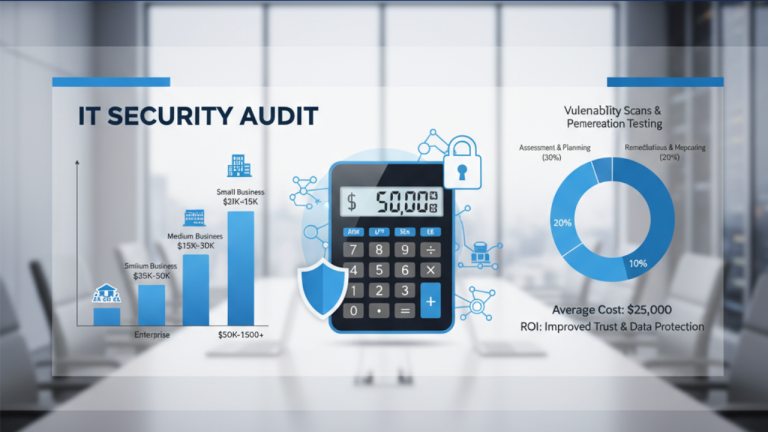
Cost-Effectiveness Analysis: Investing in regular IT audits costs significantly less than recovering from security breaches. While a comprehensive small business audit typically ranges from $3,000 to $8,000, the average cost of a data breach for small businesses reaches $8 million when factoring in downtime, recovery, legal fees, and reputation damage.
Regulatory Relevance: Many small businesses must comply with industry regulations like HIPAA for healthcare, PCI-DSS for payment processing, or GDPR for customer data protection. Regular audits ensure compliance while avoiding penalties that can reach millions of dollars for violations.
Risk Reduction Impact: Systematic IT audits reduce security risks by 60-70% according to cybersecurity research. This risk reduction translates into lower insurance premiums, improved customer confidence, and reduced likelihood of business-disrupting security incidents.
Essential Components of a Cost-Effective Small Business IT Audit
A comprehensive small business IT audit covers six critical areas that provide maximum security value within reasonable budget constraints. Each component addresses specific security risks while remaining practical for small business implementation.
Network Security Assessment: Network security forms the foundation of your IT security posture. Essential components include firewall configuration validation, wireless network security verification, and network access control evaluation. Small businesses can achieve effective network security through proper router configuration, guest network isolation, and basic intrusion detection using affordable tools like pfSense or commercial solutions under $200 monthly.
Data Protection Evaluation: Data protection assessment examines backup systems, encryption implementation, and access controls. Critical areas include automated backup verification, data encryption at rest and in transit, and user access management. Cost-effective solutions include cloud backup services starting at $50 monthly and encryption tools that integrate with existing systems without requiring expensive infrastructure changes.
Compliance Review: Industry-specific compliance requirements vary significantly but share common elements like data protection, breach notification procedures, and employee training documentation. Priority should focus on regulations that directly impact your business operations, with GDPR affecting any business handling EU customer data, HIPAA applying to healthcare-related services, and PCI-DSS required for payment processing.
Physical Security Assessment: Physical security often receives insufficient attention in small businesses but represents a significant vulnerability. Essential elements include server room access controls, workstation security policies, and device theft prevention measures. Cost-effective implementations include keycard systems for sensitive areas, security cable locks for equipment, and basic surveillance systems starting under $500.
Policy and Procedure Review: Documentation and policy evaluation ensures your security measures align with business operations and regulatory requirements. Critical components include incident response procedures, employee security training records, and change management documentation. Small businesses can implement effective policies using templates and frameworks available through NIST and industry associations.
Performance and Efficiency Analysis: System performance evaluation identifies security tools that may impact business operations while ensuring adequate protection levels. This includes software licensing optimization, hardware performance monitoring, and security tool effectiveness measurement. Regular performance assessment prevents security measures from becoming operational bottlenecks.
Step-by-Step Small Business IT Audit Process
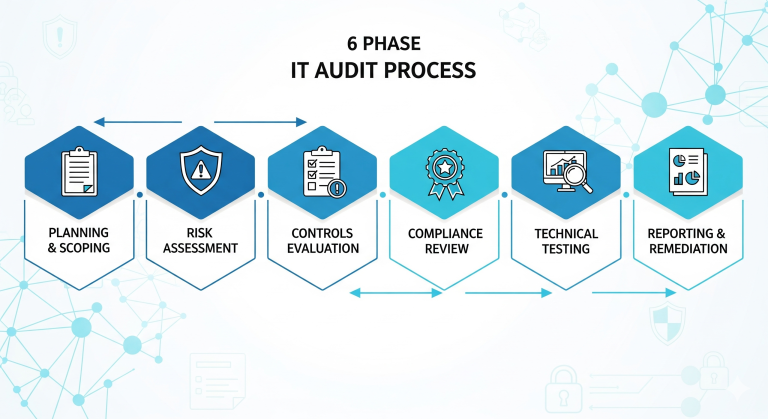
Conducting an effective small business IT audit requires a structured approach that maximizes security coverage while minimizing business disruption. This six-phase process provides comprehensive assessment within typical small business resource constraints.
Phase 1 – Planning and Preparation (1-2 weeks): Audit planning begins with scope definition and resource allocation. Essential activities include asset inventory creation, stakeholder identification, and documentation gathering. Small businesses should allocate 10-15 hours for this phase, focusing on critical systems and data repositories that support core business functions.
Phase 2 – Risk Assessment (2-3 days): Risk assessment identifies potential threats and vulnerabilities affecting your business operations. This phase includes threat modeling, asset criticality evaluation, and vulnerability prioritization. Tools like NIST Cybersecurity Framework provide structured approaches for small businesses to assess risks systematically without requiring extensive security expertise.
Phase 3 – Security Testing (3-5 days): Security testing validates the effectiveness of existing controls through automated scanning and manual verification. Essential activities include vulnerability scanning using tools like Nessus Essentials, network penetration testing with OpenVAS, and social engineering awareness evaluation. Small businesses can perform basic testing internally while engaging specialists for advanced penetration testing when budget allows.
Phase 4 – Compliance Validation (2-3 days): Compliance validation ensures your security controls meet regulatory requirements relevant to your industry and business operations. This phase includes regulatory requirement mapping, control effectiveness testing, and documentation gap analysis. Focus should prioritize regulations with the highest penalty risks and customer requirements.
Phase 5 – Documentation and Reporting (2-3 days): Comprehensive documentation captures audit findings, risk assessments, and improvement recommendations in actionable formats. Reports should prioritize findings by risk level and implementation cost, providing clear guidance for security investment decisions. Executive summaries should focus on business impact and ROI justification.
Phase 6 – Implementation Planning (1-2 weeks): Implementation planning transforms audit findings into actionable improvement roadmaps with realistic timelines and budget allocations. This phase includes remediation prioritization, resource allocation planning, and progress monitoring framework development. Small businesses should focus on quick wins that provide immediate security improvements while planning longer-term strategic enhancements.
Small Business IT Audit Checklist: Priority Areas and Quick Wins
This comprehensive checklist provides practical guidance for conducting thorough IT audits while focusing on areas that deliver maximum security value for small business investments.
Critical Priority Items (Address Immediately):
- Administrative Access Security: Change all default passwords, implement unique admin credentials, enable multi-factor authentication for administrative accounts
- Firewall Configuration: Verify firewall activation, review rule configurations, ensure unnecessary ports are closed
- Antivirus Protection: Confirm antivirus software installation on all devices, validate automatic updates, verify real-time scanning activation
- Data Backup Verification: Test backup systems, confirm automated scheduling, validate data recovery procedures
- Software Update Status: Install critical security patches, enable automatic updates where appropriate, maintain update logs
High Priority Items (Within 30 Days):
- Employee Access Controls: Review user permissions, implement principle of least privilege, disable unused accounts
- Network Monitoring: Deploy basic network monitoring tools, configure security alerts, establish baseline performance metrics
- Incident Response Planning: Develop basic incident response procedures, identify key contacts, create communication protocols
- Security Awareness Training: Conduct employee security training, implement phishing awareness programs, document training completion
- Mobile Device Security: Implement mobile device management policies, secure business data on personal devices, establish remote wipe capabilities
Medium Priority Items (3-6 Months):
- Compliance Documentation: Develop comprehensive security policies, create compliance evidence files, establish audit trails
- Advanced Security Tools: Implement endpoint detection and response solutions, deploy security information and event management systems
- Third-Party Risk Assessment: Evaluate vendor security practices, implement vendor management procedures, review service agreements
- Business Continuity Planning: Develop disaster recovery procedures, test business continuity plans, establish alternative operational procedures
Ongoing Monitoring Requirements:
- Regular Security Scans: Schedule monthly vulnerability assessments, conduct quarterly penetration testing, monitor security tool effectiveness
- Policy Updates: Review security policies annually, update procedures based on business changes, maintain compliance documentation
- Performance Reviews: Monitor system performance impacts, evaluate security tool effectiveness, assess employee compliance
Cost-Effective Implementation Tools: Small businesses can implement most checklist items using affordable tools and services. Free options include Windows Defender for antivirus protection, pfSense for firewall management, and OWASP tools for security testing. Commercial solutions under $100 monthly include cloud backup services, basic security monitoring, and employee training platforms.
Budget-Friendly IT Audit Tools and Resources for Small Businesses
Cost-effective IT audit implementation relies on selecting appropriate tools that provide enterprise-level security capabilities within small business budgets. These recommendations focus on solutions offering maximum security value for minimal investment.
Free Security Scanning Tools: Several professional-grade security tools offer free versions suitable for small business use. Nessus Essentials provides vulnerability scanning for up to 16 IP addresses, sufficient for most small business networks. OpenVAS offers comprehensive vulnerability assessment capabilities without licensing costs. OWASP ZAP provides web application security testing tools used by security professionals worldwide.
Low-Cost Compliance Solutions: Compliance management platforms designed for small businesses start under $100 monthly and include policy templates, audit trail management, and regulatory requirement tracking. Solutions like Vanta and Drata offer automated compliance monitoring for frameworks like SOC 2 and GDPR, reducing manual compliance workload significantly.
Cloud-Based Audit Platforms: Software-as-a-Service audit platforms provide enterprise capabilities without infrastructure investment. Many platforms offer small business pricing tiers starting at $50-200 monthly, including automated security monitoring, compliance tracking, and incident management capabilities.
Open Source Security Solutions: Open source alternatives provide equivalent functionality to expensive commercial tools. Security Onion offers network security monitoring, OSSEC provides host-based intrusion detection, and Suricata delivers network intrusion detection capabilities. These solutions require more technical expertise but offer significant cost savings.
Government and Industry Resources: Government agencies provide free cybersecurity resources specifically designed for small businesses. CISA offers vulnerability scanning services, the SBA provides cybersecurity guidance, and NIST frameworks offer structured approaches to security implementation. Industry associations often provide member-exclusive resources and tool discounts.
Internal Audit Capability Development: Building internal audit capabilities reduces long-term costs while improving security awareness throughout the organization. Training programs from organizations like ISACA and CompTIA provide cybersecurity certification paths suitable for small business IT staff. Online resources and community colleges offer affordable cybersecurity education options.
Compliance Made Simple: Regulatory Requirements for Small Businesses
Regulatory compliance often overwhelms small businesses due to complex requirements and potential penalties. This simplified approach focuses on practical compliance achievement without unnecessary complexity or expense.
Universal Data Protection Requirements: All businesses handling customer information must implement basic data protection measures regardless of specific regulatory frameworks. Essential requirements include data encryption, access controls, breach notification procedures, and employee training documentation. These foundational controls satisfy multiple regulatory requirements simultaneously.
Industry-Specific Compliance Priorities: Healthcare organizations must prioritize HIPAA compliance, focusing on patient data protection, access logging, and business associate agreements. Financial services require attention to SOX controls, customer data protection, and transaction monitoring. Retail businesses processing payments must implement PCI-DSS requirements for cardholder data protection.
GDPR and State Privacy Law Compliance: Any business serving European customers or operating in states with comprehensive privacy laws must implement privacy controls. Essential requirements include privacy policy publication, data subject rights procedures, consent management, and breach notification capabilities. Many requirements overlap with general cybersecurity best practices.
Cost-Effective Compliance Implementation: Compliance achievement doesn’t require expensive consulting or complex systems. Many requirements can be satisfied through proper policy documentation, employee training, and basic security controls. Free resources from regulatory agencies provide implementation guidance and template documents.
Documentation and Evidence Management: Compliance audits require evidence of control implementation and effectiveness. Essential documentation includes policy acknowledgments, training records, incident logs, and access control reviews. Simple spreadsheet-based tracking systems often satisfy documentation requirements for small businesses.
Penalty Risk Assessment: Understanding penalty structures helps prioritize compliance efforts effectively. GDPR fines can reach 4% of annual revenue, HIPAA penalties range from $100 to $50,000 per violation, and PCI-DSS non-compliance can result in monthly fines plus increased transaction costs. This risk analysis guides compliance investment decisions.
Internal vs. External IT Audits: Making the Right Choice for Your Small Business
Choosing between internal and external audit approaches significantly impacts cost, effectiveness, and resource allocation. Understanding the advantages and limitations of each approach enables informed decision-making based on business needs and capabilities.
Internal Audit Advantages: Internal audits provide cost control, ongoing monitoring capabilities, and deep business context understanding. Staff members understand business processes, system configurations, and operational constraints better than external auditors. Internal audits can be conducted more frequently, enabling continuous security improvement rather than annual assessments.
External Audit Benefits: External auditors bring objective perspectives, specialized expertise, and regulatory credibility that internal staff may lack. They provide comparative insights from similar businesses and offer advanced testing capabilities that justify their higher costs. External audits often satisfy customer and partner requirements for independent security validation.
Cost Analysis Comparison: Internal audit costs include staff time, training, and tool acquisition, typically ranging from $2,000-5,000 annually for comprehensive programs. External audits cost $5,000-15,000 for comprehensive assessments but require less internal resource allocation. Hybrid approaches often provide optimal cost-effectiveness, combining internal monitoring with periodic external validation.
Capability Requirements Assessment: Internal audit success requires staff with cybersecurity knowledge, time allocation for audit activities, and access to appropriate tools and training. Many small businesses lack these capabilities initially but can develop them over time through training and experience. External audits require less internal capability but provide fewer learning opportunities for staff development.
Hybrid Approach Implementation: Many small businesses achieve optimal results through hybrid approaches combining internal monitoring with periodic external validation. This approach maintains cost control while ensuring objective assessment and regulatory compliance. Typical implementations include quarterly internal assessments with annual external audits.
Decision Criteria Framework: Audit approach selection should consider business size, regulatory requirements, internal capabilities, and budget constraints. Businesses with fewer than 25 employees often benefit from external audits, while larger small businesses may justify internal capability development. Regulatory requirements for independent audits may limit choice in some industries.
Implementing Audit Findings: Practical Remediation on a Small Business Budget
Successful audit programs depend on effective implementation of audit findings within realistic budget and timeline constraints. This practical approach prioritizes security improvements based on risk reduction and cost-effectiveness.
Risk-Based Remediation Prioritization: Audit findings should be prioritized based on risk level, implementation cost, and business impact. Critical vulnerabilities requiring immediate attention include default passwords, missing security patches, and inadequate backup systems. Medium-risk items like policy updates and training programs can be addressed over 3-6 month periods.
Budget Allocation Strategies: Small businesses should allocate security improvement budgets across immediate fixes, medium-term enhancements, and long-term strategic investments. Typical allocation includes 40% for immediate critical fixes, 35% for planned improvements over 6-12 months, and 25% for strategic security initiatives extending beyond one year.
Quick Win Implementation: Many audit findings can be addressed with minimal cost and immediate impact. Password policy enforcement, software updates, and basic firewall configuration often require only time investment. These quick wins provide immediate security improvement while building momentum for larger initiatives.
Phased Implementation Planning: Complex security improvements should be implemented in phases to manage costs and minimize business disruption. A typical 90-day implementation plan addresses critical vulnerabilities immediately, implements medium-risk improvements within 30-60 days, and establishes ongoing monitoring and maintenance procedures by day 90.
Progress Monitoring and Measurement: Effective implementation requires progress tracking and success measurement. Key metrics include vulnerability reduction, security incident frequency, compliance score improvement, and system performance maintenance. Regular progress reviews ensure implementation stays on schedule and within budget.
Ongoing Audit Cycle Establishment: Sustainable security improvement requires establishing regular audit cycles and continuous improvement processes. Many small businesses benefit from quarterly internal reviews with annual external audits, enabling ongoing security enhancement while managing costs effectively.
ROI and Business Benefits: Justifying IT Audit Investment
IT audit investment provides measurable business value through risk reduction, operational efficiency, and growth enablement. Understanding these benefits helps justify audit expenses and secure ongoing organizational support.
Cost Avoidance Through Breach Prevention: Regular IT audits significantly reduce data breach probability and associated costs. The average small business data breach costs $8 million, while comprehensive annual audits typically cost $3,000-8,000. This represents a potential 100:1 return on investment through breach prevention alone.
Operational Efficiency Improvements: Audit processes often identify operational inefficiencies and system optimization opportunities. Common improvements include software licensing optimization, hardware lifecycle management, and process automation. These efficiency gains typically reduce IT operational costs by 15-25% annually.
Business Growth Enablement: Security audits enable business growth through improved customer confidence, partner relationship development, and competitive differentiation. Many enterprise customers require vendor security assessments, making audit documentation essential for business development opportunities.
Insurance and Financing Benefits: Comprehensive security programs often qualify for cyber insurance premium reductions of 10-20%. Additionally, businesses with strong security practices may receive better financing terms and lower interest rates, as financial institutions increasingly consider cybersecurity risks in lending decisions.
Regulatory Compliance Value: Proactive compliance through regular audits avoids penalties and enables business opportunities in regulated markets. HIPAA violations average $1.5 million per incident, while PCI-DSS non-compliance can cost $50,000-90,000 monthly until resolved.
Long-term Investment Perspective: IT audit programs provide cumulative value through security maturity development, process improvement, and organizational learning. Multi-year audit programs typically show increasing ROI as security practices mature and incident frequency decreases.
Frequently Asked Questions About Small Business IT Audits
How often should small businesses conduct IT audits? Most small businesses benefit from annual comprehensive audits with quarterly internal assessments. High-risk industries or businesses handling sensitive data may require semi-annual external audits. The frequency should balance security needs with budget constraints and operational impact.
What is the average cost of a small business IT audit? Small business IT audits typically cost $3,000-8,000 for external comprehensive assessments, depending on business size and complexity. Internal audits cost significantly less but require staff time and capability development. Hybrid approaches often provide optimal cost-effectiveness.
Can small businesses conduct IT audits internally? Yes, small businesses can conduct basic IT audits internally with proper training and tools. However, external audits provide objectivity and expertise that internal assessments may lack. Many businesses use hybrid approaches combining internal monitoring with periodic external validation.
What tools do small businesses need for IT audits? Essential tools include vulnerability scanners like Nessus Essentials, network monitoring solutions, and compliance tracking platforms. Many effective tools offer free versions or small business pricing tiers under $200 monthly. Open source alternatives provide enterprise capabilities without licensing costs.
How do IT audits help with regulatory compliance? IT audits verify compliance with industry regulations like HIPAA, PCI-DSS, and GDPR. Regular audits identify compliance gaps before they become violations, document compliance efforts for regulatory review, and ensure ongoing adherence to changing requirements.
What should small businesses do if they fail an audit? Audit failures should be viewed as learning opportunities rather than defeats. Develop remediation plans addressing critical findings first, implement improvements within realistic timelines, and conduct follow-up assessments to verify correction effectiveness. Most audit findings can be addressed with proper planning and resource allocation.
Conclusion
Small business IT audits represent essential investments in business protection, operational efficiency, and growth enablement. While the complexity of cybersecurity can seem overwhelming, systematic audit approaches provide practical pathways to comprehensive security within realistic budget constraints.
Key Implementation Principles: Successful small business audit programs focus on essential security controls rather than comprehensive enterprise-level assessments. Prioritizing critical vulnerabilities, implementing cost-effective solutions, and establishing ongoing improvement processes provide maximum security value for limited resources.
Starting Your Audit Journey: Begin with basic internal assessments using free tools and resources, addressing critical vulnerabilities immediately while developing longer-term security improvement plans. Many small businesses achieve significant security improvements through systematic approaches that require more time than money.
Long-term Security Investment: IT audits should be viewed as ongoing investments in business sustainability rather than one-time compliance exercises. Regular assessments, continuous improvement, and security awareness development create cumulative value that protects business operations and enables growth opportunities.
The investment in small business IT audits provides exceptional return through risk reduction, compliance achievement, and business enablement. When implemented systematically and sustained over time, audit programs become competitive advantages that differentiate your business in increasingly security-conscious markets.
Ready to strengthen your business security posture? Our comprehensive IT audit process framework provides detailed methodology and implementation guidance to complement the practical approaches outlined in this guide.