
Cybersecurity threats reached unprecedented levels in 2025, with the National Institute of Standards and Technology (NIST) reporting over 17,500 new vulnerabilities discovered in the first half of the year alone. As organizations face increasingly sophisticated attacks, professional IT audit services have become essential for identifying vulnerabilities before malicious actors exploit them. However, with IT security audit costs ranging from $3,000 to $50,000, business leaders must make informed decisions about their security investments.
This comprehensive guide addresses the critical questions every organization faces: What do IT audit services actually include? How much should you budget? Which type of audit does your business need? Whether you’re a startup evaluating your first security assessment or an enterprise planning comprehensive compliance audits, this guide provides actionable insights from analyzing top cybersecurity audit companies and real-world pricing data. Whether you need internal or external IT audits, understanding these fundamentals is crucial for making informed decisions about your organization’s security posture.
What Are IT Audit Services? (Complete Definition & Scope)
IT audit services encompass comprehensive evaluations of an organization’s information technology infrastructure, security controls, and compliance posture. These professional assessments examine everything from network configurations and access controls to data protection measures and regulatory compliance requirements. Unlike basic vulnerability scans, IT audits provide strategic insights that help organizations strengthen their overall security framework while meeting industry-specific regulatory requirements.
Core Components of IT Audit Services
Professional IT audit services typically include several key components. Security assessments evaluate technical controls, firewall configurations, and intrusion detection systems. Compliance audits verify adherence to frameworks like SOC 2, HIPAA, PCI DSS, and ISO 27001. Operational audits review IT governance structures, change management processes, and disaster recovery procedures. Risk assessments identify potential threats and their business impact.
The scope can vary significantly based on organizational needs. Some audits focus on specific systems or applications, while others provide comprehensive enterprise-wide evaluations. Cloud environments, mobile devices, and third-party integrations often require specialized attention during modern IT audits.
Types of IT Audits: Internal vs External
Organizations can choose between internal and external audit approaches, each serving different purposes. Internal audits are conducted by in-house teams or staff augmentation, providing ongoing monitoring and continuous improvement opportunities. External audits involve independent third-party assessments that offer objective perspectives and meet compliance requirements for stakeholder reporting.
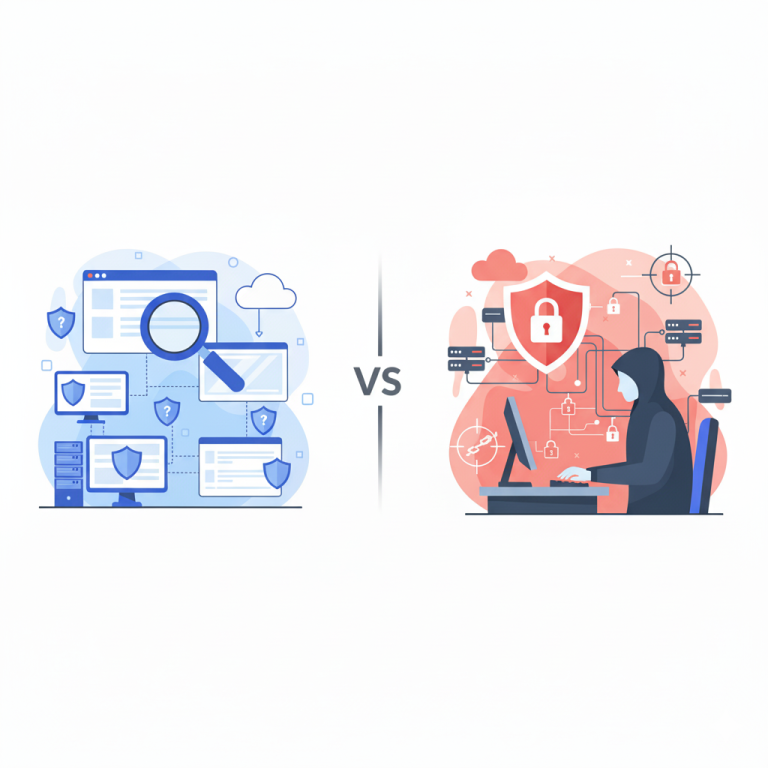
To understand which approach best fits your organization, explore our detailed comparison of internal vs external IT audits. Many organizations also wonder about the difference between vulnerability assessments and penetration testing – both critical components of comprehensive IT audits.
Business Value and Risk Mitigation
Professional IT audits deliver measurable business value beyond security improvements. They help organizations avoid costly data breaches, meet customer security requirements, and reduce cyber insurance premiums. Audits also identify operational inefficiencies and provide roadmaps for technology improvements.
Regular audits demonstrate due diligence to stakeholders, customers, and regulatory bodies. They create audit trails that support compliance efforts and provide evidence of security investment during insurance claims or legal proceedings.
IT Audit Services Cost Breakdown: What to Expect in 2025
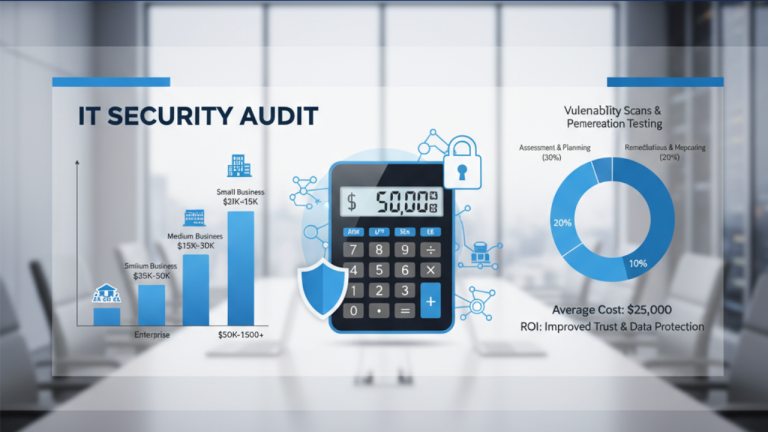
Understanding IT audit costs helps organizations budget appropriately and select the right service level for their needs. Pricing varies significantly based on organizational size, audit scope, compliance requirements, and chosen methodology. Industry data shows costs typically range from $3,000 for small business basic assessments to over $50,000 for comprehensive enterprise audits.
Small Business IT Audit Costs (1-50 employees)
Small businesses typically invest $3,000 to $15,000 in professional IT audits. Basic security assessments focusing on essential controls and common vulnerabilities usually cost $3,000 to $7,000. Comprehensive audits including compliance frameworks like SOC 2 Type I range from $8,000 to $15,000.
Cost factors for small businesses include the number of systems, applications, and users. Cloud-first organizations often see lower costs due to simplified infrastructure, while businesses with legacy systems or complex integrations face higher fees. Remote work environments require additional endpoint security assessments.
Medium Business IT Audit Costs (51-500 employees)
Medium-sized organizations typically invest $15,000 to $30,000 in IT audits. These assessments cover more complex infrastructure, multiple locations, and diverse technology stacks. Compliance audits for frameworks like SOC 2 Type II, HIPAA, or PCI DSS add $5,000 to $15,000 to base costs.
Medium businesses often require hybrid approaches combining automated scanning with manual testing. Multi-location assessments, vendor integrations, and specialized compliance requirements influence pricing. Organizations with sensitive data or regulatory requirements face higher costs due to increased testing depth.
Enterprise IT Audit Costs (500+ employees)
Enterprise organizations invest $30,000 to $50,000 or more in comprehensive IT audits. Large-scale assessments covering global infrastructure, complex compliance requirements, and multiple business units require extensive resources. Fortune 500 companies often spend $75,000 to $150,000 on annual audit programs.
Enterprise costs include specialized testing for advanced persistent threats, supply chain security, and emerging technology platforms. Multi-framework compliance (SOX, ISO 27001, FedRAMP) requires coordinated audit approaches that increase complexity and cost.
Additional Cost Considerations
Several factors can increase audit costs beyond base pricing. Travel expenses for on-site assessments typically add $2,000 to $10,000 depending on location and duration. Compliance consulting for gap remediation costs $150 to $300 per hour. Specialized testing for IoT devices, industrial systems, or proprietary applications requires additional expertise.
Re-audit costs for failed assessments range from 25% to 50% of original fees. Organizations can minimize these expenses through proper preparation and internal testing before formal audits.
For detailed pricing breakdowns by business size, see our comprehensive IT security audit cost guide with real-world examples and budget calculators. SaaS companies should review our SOC 2 audit cost analysis for compliance-specific pricing insights. Healthcare organizations need specialized budgeting – explore our HIPAA compliance audit cost guide for industry-specific pricing.
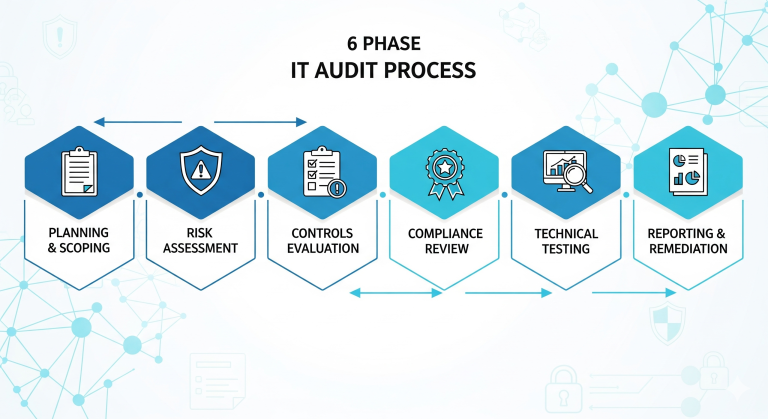
The Complete IT Audit Process: 7 Essential Phases
Professional IT audits follow structured methodologies that ensure comprehensive coverage and consistent results. Understanding this process helps organizations prepare effectively and set realistic expectations for timeline and resource requirements. Most audits complete within 4 to 12 weeks depending on scope and organizational complexity.
Phase 1: Pre-Audit Planning and Scope Definition
The audit process begins with detailed planning and scope definition. Auditors work with stakeholders to identify critical systems, compliance requirements, and business objectives. This phase includes contract negotiation, resource allocation, and timeline establishment.
Key activities include asset inventory reviews, compliance framework selection, and stakeholder interviews. Auditors define testing methodologies, establish communication protocols, and identify any limitations or exclusions. Proper planning prevents scope creep and ensures audit efficiency.
Timeline: 1-2 weeks for most organizations, up to 4 weeks for complex enterprises.
Phase 2: Asset Inventory and Documentation Review
Auditors conduct comprehensive asset discovery and documentation analysis. This includes network mapping, system cataloging, and policy reviews. Organizations provide network diagrams, security policies, incident response procedures, and compliance documentation.
Documentation requirements typically include security policies, network architectures, user access reviews, and change management procedures. Missing or outdated documentation can extend audit timelines and increase costs.
Timeline: 1-2 weeks, depending on documentation completeness and system complexity.
Phase 3: Vulnerability Assessment and Testing
Technical testing begins with automated vulnerability scanning followed by manual verification. Auditors test network security, application security, and system configurations. This phase identifies technical vulnerabilities and assesses existing security controls.
Testing methodologies include network scanning, web application testing, wireless security assessment, and social engineering simulations. Auditors use industry-standard tools while following non-disruptive testing protocols to avoid business disruption.
Timeline: 2-4 weeks for comprehensive technical testing.
Phase 4: Compliance Verification and Gap Analysis
Auditors evaluate organizational compliance with relevant frameworks and regulations. This includes control testing, evidence gathering, and gap identification. Compliance verification ensures organizations meet customer requirements and regulatory obligations.
Framework assessments cover technical controls, administrative procedures, and physical security measures. Auditors document compliance status and identify areas requiring remediation before certification or attestation.
Timeline: 1-3 weeks depending on framework complexity and organizational maturity.
Phase 5: Risk Assessment and Prioritization
Identified vulnerabilities and compliance gaps undergo risk analysis and prioritization. Auditors evaluate potential business impact, likelihood of exploitation, and remediation complexity. This analysis helps organizations focus resources on the most critical issues.
Risk scoring typically follows industry standards like CVSS (Common Vulnerability Scoring System) while considering organizational context. Business-critical systems and high-impact vulnerabilities receive priority attention.
Timeline: 1 week for analysis and prioritization.
Phase 6: Reporting and Recommendations
Auditors compile findings into comprehensive reports with executive summaries and technical details. Reports include vulnerability descriptions, risk ratings, and specific remediation recommendations. Clear communication helps stakeholders understand findings and plan responses.
Report components include executive dashboards, technical findings, compliance status, and remediation roadmaps. Professional reports provide evidence for compliance purposes and guide internal improvement efforts.
Timeline: 1-2 weeks for report compilation and review.
Phase 7: Remediation Planning and Follow-up
The final phase involves remediation planning and follow-up activities. Auditors work with organizations to prioritize fixes, estimate remediation timelines, and plan re-testing activities. This phase ensures audit value extends beyond initial findings.
Follow-up activities include remediation verification, compliance attestation, and continuous monitoring recommendations. Many organizations schedule annual audits or quarterly assessments to maintain security posture.
Timeline: Ongoing, with initial planning completed within 1 week of report delivery.
For a detailed walkthrough of each phase, follow our comprehensive cybersecurity audit process guide with timeline templates and stakeholder checklists. Successful audits require proper preparation – use our 30-day IT audit preparation checklist to ensure readiness.
Post-audit success depends on effective implementation – our IT audit findings remediation guide provides prioritization frameworks and implementation strategies. Professional documentation is crucial – access our IT audit report templates for executive summaries and technical findings.
Types of IT Audit Services: Which One Does Your Business Need?
Organizations can choose from several audit types depending on their security objectives, compliance requirements, and business goals. Understanding these options helps businesses select appropriate service levels while avoiding unnecessary costs or insufficient coverage.
Security-Focused Audits
Cybersecurity audits concentrate on identifying technical vulnerabilities and security control effectiveness. These assessments evaluate firewalls, intrusion detection systems, endpoint protection, and access controls. Security audits often include penetration testing and vulnerability assessments to simulate real-world attack scenarios.
Network security audits focus specifically on network infrastructure, including routers, switches, wireless networks, and network segmentation. These audits identify configuration weaknesses and unauthorized access points that could compromise organizational security.
Cloud-first organizations need specialized approaches – explore our cloud security audit guide covering AWS, Azure, and GCP requirements. To optimize your security testing strategy, understand the key differences between vulnerability assessments and penetration testing.
Compliance-Focused Audits
Regulatory compliance audits verify adherence to industry-specific requirements like HIPAA, PCI DSS, or SOX. These audits focus on control implementation, documentation requirements, and evidence gathering necessary for compliance attestation.
Framework assessments evaluate organizational alignment with standards like ISO 27001, NIST Cybersecurity Framework, or SOC 2. These audits help organizations achieve certifications while improving overall security posture.
Third-party audits assess vendor security practices and supply chain risks. These evaluations help organizations meet due diligence requirements while protecting against supply chain attacks.
Operational Audits
IT governance audits evaluate technology management processes, change control procedures, and strategic alignment. These assessments identify operational inefficiencies and recommend process improvements.
Business continuity audits test disaster recovery capabilities, backup procedures, and incident response plans. These audits ensure organizations can maintain operations during security incidents or system failures.
Data governance audits examine data classification, retention policies, and privacy controls. These assessments help organizations protect sensitive information while meeting data protection regulations.
Specialized Audit Services
Application security audits focus on custom software, web applications, and mobile apps. These assessments identify coding vulnerabilities, authentication weaknesses, and data handling issues.
Industrial control system (ICS) audits evaluate operational technology environments in manufacturing, utilities, and critical infrastructure. These specialized audits address unique risks in industrial environments.
Cloud security audits assess public cloud configurations, container security, and serverless architectures. These audits help organizations secure modern cloud-native environments.
Modern audits rely on sophisticated tools – review our analysis of top network security audit tools for 2025 to understand current assessment capabilities.
IT Audit Compliance Requirements by Industry
Different industries face unique regulatory requirements that influence audit scope, methodology, and reporting. Understanding industry-specific compliance needs helps organizations select appropriate audit services while ensuring they meet all applicable requirements.
Healthcare Industry Requirements
Healthcare organizations must comply with HIPAA Privacy and Security Rules that protect patient health information. These requirements mandate administrative, physical, and technical safeguards for electronic protected health information (ePHI). Healthcare IT audits evaluate access controls, encryption implementation, audit logging, and breach notification procedures.
Business associates including cloud providers, billing companies, and technology vendors must also maintain HIPAA compliance. Many healthcare organizations require business associate agreements (BAAs) and regular security assessments from their vendors.
Emerging requirements include telehealth security, medical device cybersecurity, and interoperability standards. Healthcare audits increasingly focus on API security and health information exchange protocols.
Healthcare Organizations: Navigate complex requirements with our healthcare IT audit guide covering HIPAA compliance and patient data security.
Financial Services Industry Requirements
Financial institutions face multiple overlapping regulations including SOX, GLBA, PCI DSS, and state privacy laws. These requirements mandate strong internal controls, customer data protection, and regulatory reporting capabilities.
Banking regulations require annual risk assessments, penetration testing, and vendor management programs. Credit unions and community banks often need cost-effective approaches that meet regulatory requirements without exceeding limited budgets.
Fintech companies must navigate complex regulatory landscapes while maintaining innovation and speed to market. Many fintech organizations pursue SOC 2 compliance to demonstrate security maturity to banking partners.
Financial Services: Ensure regulatory compliance with our banking and financial services IT audit guide addressing SOX, GLBA, and PCI requirements.
E-commerce and Retail Requirements
Organizations that process credit card transactions must comply with PCI DSS requirements. These standards mandate secure payment processing, encrypted data transmission, and regular security testing. PCI compliance levels depend on transaction volume, with Level 1 merchants facing the most stringent requirements.
E-commerce platforms must secure customer data, payment processing systems, and web applications. Retail organizations often require point-of-sale (POS) system assessments and network segmentation audits.
Omnichannel retailers face additional complexity with mobile payments, loyalty programs, and customer data analytics requiring comprehensive security assessment.
E-commerce Businesses: Protect customer payment data with our PCI DSS compliance audit guide for secure transaction processing.
Technology and SaaS Industry Requirements
Software-as-a-Service (SaaS) providers typically pursue SOC 2 Type II compliance to demonstrate security controls to enterprise customers. These audits evaluate security, availability, processing integrity, confidentiality, and privacy controls.
Cloud service providers may need additional certifications like FedRAMP for government customers or ISO 27001 for international markets. Technology companies often face customer security questionnaires and third-party risk assessments.
Startups and emerging technologies need scalable compliance approaches that grow with their business while maintaining security standards.
Government and Federal Contractor Requirements
Federal agencies and contractors must comply with FISMA requirements and NIST security standards. These mandates require comprehensive security programs, continuous monitoring, and regular assessments.
Defense contractors may need CMMC (Cybersecurity Maturity Model Certification) compliance to handle controlled unclassified information (CUI). These requirements mandate advanced security controls and third-party assessments.
State and local governments face varying requirements but increasingly adopt frameworks like NIST Cybersecurity Framework for security guidance.
Federal Contractors: Ensure government compliance with our NIST cybersecurity framework audit guide for federal requirements.
International Compliance Considerations
Global organizations must navigate multiple regulatory frameworks including GDPR in Europe, PIPEDA in Canada, and emerging data protection laws worldwide. These requirements often mandate data localization, privacy impact assessments, and breach notification procedures.
ISO 27001 certification provides internationally recognized security standards that help organizations demonstrate security maturity across global markets.
International Organizations: Meet global standards with our ISO 27001 audit requirements guide and implementation checklist.
How to Choose the Right IT Audit Service Provider
Selecting the appropriate audit provider significantly impacts audit quality, cost, and business value. Organizations must evaluate provider capabilities, industry expertise, and cultural fit while balancing cost considerations with quality requirements.
Types of IT Audit Providers
Big Four accounting firms (Deloitte, PwC, EY, KPMG) offer comprehensive audit services with global reach and deep regulatory expertise. These firms excel at complex compliance audits and enterprise-scale assessments but may have higher costs and less flexibility for smaller organizations.
Specialized cybersecurity firms provide technical depth and focused expertise in specific security domains. These providers often offer competitive pricing and innovative methodologies but may lack breadth in business process auditing or regulatory compliance.
Regional consulting firms deliver personalized service and local market knowledge. These providers often provide excellent value for small to medium businesses while maintaining partner-level attention throughout engagements.
Boutique security consultancies offer specialized expertise in niche areas like industrial control systems, cloud security, or specific compliance frameworks. These firms provide deep technical knowledge but may have limited capacity or geographic coverage.
Key Selection Criteria
Industry experience should align with your organization’s sector and regulatory requirements. Healthcare organizations need HIPAA expertise, while financial services require banking regulation knowledge. Ask for client references in similar industries and compliance frameworks.
Technical certifications validate auditor expertise and methodological rigor. Look for certifications like CISSP, CISA, CISM, or framework-specific credentials like Certified SOC 2 Practitioner. Team composition should include both technical specialists and business process experts.
Methodology and tools should reflect current best practices and industry standards. Evaluate the provider’s approach to risk assessment, testing protocols, and reporting formats. Advanced providers use automated tools while maintaining manual verification capabilities.
Communication and reporting quality directly impacts audit value. Review sample reports to evaluate clarity, actionability, and executive summary quality. Ensure the provider can communicate technical findings to both technical teams and business stakeholders.
Provider Evaluation Process
Request for proposal (RFP) processes help standardize provider evaluation and ensure comprehensive coverage of requirements. Include scope definition, timeline expectations, deliverable requirements, and cost parameters in RFP documents.
Reference checks provide insights into provider performance, communication quality, and problem-solving capabilities. Ask references about project management, issue resolution, and post-audit support quality.
Pilot engagements allow organizations to evaluate provider capabilities on smaller projects before committing to comprehensive audits. Consider starting with limited-scope assessments or specific compliance evaluations.
The decision often comes down to scope and budget – our internal vs external IT audit comparison helps determine the right approach for your organization. Small businesses have unique provider selection criteria – review our small business IT audit guide for cost-effective solutions and vendor selection tips.
Preparing Your Organization for an IT Audit
Effective audit preparation significantly impacts assessment efficiency, cost control, and result quality. Well-prepared organizations complete audits faster, receive more actionable recommendations, and achieve better compliance outcomes. Preparation typically requires 30-60 days depending on organizational readiness and audit scope.
Documentation Gathering and Organization
Asset inventory compilation forms the foundation of audit preparation. Organizations should catalog all systems, applications, network devices, and data repositories within audit scope. Include version information, ownership details, and business criticality ratings for each asset.
Policy and procedure documentation must be current and accessible. Gather security policies, incident response procedures, change management processes, and user access controls. Many organizations discover documentation gaps during preparation, allowing time for updates before formal audit begins.
Previous audit reports and remediation evidence demonstrate ongoing security improvements. Compile findings from prior assessments, penetration tests, and compliance audits along with evidence of completed remediation activities.
Network diagrams and system architectures help auditors understand infrastructure complexity and identify testing requirements. Ensure diagrams reflect current configurations and include security controls, network segmentation, and data flows.
Internal Team Preparation and Training
Stakeholder identification ensures appropriate personnel participate in audit activities. Include representatives from IT operations, security, compliance, legal, and business units. Designate primary contacts for each functional area and establish escalation procedures.
Calendar coordination prevents scheduling conflicts and ensures stakeholder availability. Block time for interviews, testing activities, and documentation reviews. Consider business cycles and peak operational periods when scheduling audit activities.
Internal communication helps prepare staff for audit activities and sets expectations for their participation. Explain audit objectives, timelines, and individual responsibilities. Address any concerns about job security or performance evaluation to ensure cooperation.
Technical Environment Preparation
System access provisioning for auditors requires careful planning to balance security with audit efficiency. Create temporary accounts with appropriate access levels and monitoring capabilities. Document all access grants and establish removal procedures for audit completion.
Backup and recovery verification ensures audit activities don’t disrupt business operations. Test critical system backups and verify recovery procedures before audit testing begins. Consider scheduling testing during maintenance windows to minimize business impact.
Change management freeze during testing periods prevents configuration changes that could affect audit results. Coordinate with operations teams to establish change control procedures and exception processes for critical updates.
Cost Reduction Strategies
Thorough preparation directly reduces audit costs by improving efficiency and reducing auditor time requirements. Organizations with complete documentation and responsive stakeholders typically complete audits 25-40% faster than unprepared clients.
Pre-audit gap analysis identifies obvious issues that can be remediated before formal assessment. Internal teams can address basic configuration issues, policy updates, and documentation gaps to improve audit outcomes.
Vendor management coordination streamlines third-party assessments and reduces duplication. Coordinate audit activities with major vendors to share results and avoid redundant testing.
Success starts with thorough preparation – download our comprehensive IT audit preparation checklist with 30-day timeline and task assignments. Standardize your assessment approach with our detailed IT audit checklist covering all critical security domains.
IT Audit Results: Understanding Reports and Next Steps
Professional IT audit reports provide comprehensive documentation of findings, risk assessments, and remediation recommendations. Understanding report structure and content helps organizations prioritize remediation efforts, allocate resources effectively, and demonstrate compliance to stakeholders.
Report Structure and Key Components
Executive summaries provide high-level overviews suitable for senior management and board presentations. These sections summarize overall security posture, compliance status, and critical findings without technical detail. Executive summaries typically include risk ratings, compliance percentages, and strategic recommendations.
Technical findings detail specific vulnerabilities, configuration issues, and control deficiencies. Each finding includes vulnerability descriptions, affected systems, potential business impact, and specific remediation steps. Technical sections provide evidence supporting conclusions and testing methodologies used.
Compliance matrices map organizational controls to framework requirements, showing compliance status for each control objective. These matrices help track remediation progress and demonstrate compliance achievement to auditors and stakeholders.
Risk prioritization sections rank findings by business impact, exploitation likelihood, and remediation complexity. Professional auditors use standardized risk scoring methodologies while considering organizational context and business priorities.
Understanding Risk Ratings and CVSS Scoring
Common Vulnerability Scoring System (CVSS) provides standardized risk ratings for technical vulnerabilities. CVSS scores range from 0.0 to 10.0, with higher scores indicating greater severity. Organizations should prioritize CVSS scores above 7.0 (high) and 9.0 (critical) for immediate attention.
Business risk assessments consider organizational context beyond technical severity. Customer-facing systems, financial applications, and compliance-critical infrastructure may receive elevated priority regardless of technical scores.
Threat modeling evaluates realistic attack scenarios and potential business impact. Modern audit reports increasingly include threat-based risk assessment that considers current attack trends and organizational threat landscape.
Remediation Planning and Timeline Development
Short-term fixes address critical vulnerabilities and compliance gaps that require immediate attention. These typically include security configuration changes, access control updates, and emergency patches. Short-term remediation usually completes within 30-90 days.
Medium-term improvements involve process enhancements, policy updates, and infrastructure changes. These projects typically require 3-12 months and may involve budget allocation and vendor procurement.
Long-term strategic initiatives address fundamental architecture changes, major system replacements, and organizational transformation. Strategic remediation often spans 1-3 years and requires significant investment planning.
Budget allocation for remediation should consider both immediate costs and long-term strategic investments. Organizations typically allocate 10-25% of their IT budget for security improvements based on audit findings.
Continuous Monitoring and Follow-up
Progress tracking helps organizations maintain momentum and demonstrate improvement to stakeholders. Establish regular review meetings, milestone tracking, and status reporting to ensure remediation stays on schedule.
Validation testing confirms remediation effectiveness and prevents regression. Organizations should conduct internal testing before requesting formal validation from audit providers.
Annual audit cycles help maintain security posture and demonstrate ongoing improvement. Many compliance frameworks require annual assessments, while security-focused audits often occur every 2-3 years.
Professional reporting is essential – access our IT audit report templates for standardized formats and executive summaries. Transform findings into action with our IT audit findings remediation guide featuring prioritization frameworks and implementation roadmaps.
ROI of IT Audit Services: Measuring Business Value
IT audit investments deliver measurable returns through risk reduction, compliance cost avoidance, and operational improvements. Understanding these benefits helps organizations justify audit expenses and optimize their security investment strategies.
Risk Reduction and Breach Prevention
Data breach cost avoidance represents the most significant audit ROI component. The average cost of a data breach in 2025 exceeds $4.5 million, making even expensive audits cost-effective if they prevent a single major incident. Organizations that conduct regular audits typically experience 40-60% fewer security incidents than those without formal assessment programs.
Cyber insurance premium reductions often offset 10-25% of audit costs. Insurance providers offer significant discounts for organizations with current security assessments and documented remediation programs. Some insurers require annual audits for coverage approval or claims processing.
Business continuity protection prevents revenue loss from system outages and security incidents. Audits identify single points of failure and help organizations improve resilience against both cyber attacks and operational failures.
Compliance Cost Avoidance
Regulatory fine prevention provides substantial ROI for organizations in regulated industries. HIPAA violations can result in fines up to $1.5 million per incident, while GDPR penalties reach 4% of annual revenue. Proactive compliance audits help avoid these expensive enforcement actions.
Customer requirement fulfillment enables business development and contract renewals. Enterprise customers increasingly require security certifications like SOC 2 or ISO 27001 from their vendors. Audit-supported compliance opens new market opportunities and protects existing revenue streams.
Legal and litigation cost reduction results from documented security programs and audit trails. Organizations with formal audit programs face lower liability exposure and reduced legal costs during security incident investigations.
Operational Efficiency Improvements
Process optimization often emerges from operational audit findings. Organizations typically identify 15-30% efficiency improvements in IT operations through audit-driven process reviews. These improvements reduce ongoing operational costs while improving service quality.
Technology investment optimization helps organizations make better purchasing decisions and avoid redundant solutions. Audit findings inform strategic technology planning and help justify security infrastructure investments.
Staff productivity improvements result from streamlined security processes and reduced incident response overhead. Organizations with mature security programs spend 50-70% less time on incident management and compliance reporting.
Long-term Strategic Benefits
Market differentiation helps organizations compete more effectively by demonstrating security maturity to customers and partners. Security certifications supported by regular audits become competitive advantages in security-conscious markets.
Investor confidence increases for organizations with documented security programs and audit histories. Private equity and venture capital firms increasingly require security due diligence during investment evaluations.
Merger and acquisition readiness improves when organizations maintain current audit documentation and compliance status. Security diligence represents a major component of M&A valuations and deal timelines.
Calculate your potential return with our IT audit ROI calculator including risk mitigation values and compliance cost savings.
Conclusion
Professional IT audit services provide essential security insights and compliance support for organizations of all sizes. From small businesses investing $3,000 in basic security assessments to enterprises spending $50,000+ on comprehensive audit programs, these investments deliver measurable returns through risk reduction, compliance achievement, and operational improvements.
The key to audit success lies in understanding your organization’s specific needs, selecting appropriate audit types, and choosing qualified providers who understand your industry requirements. Whether you need healthcare HIPAA compliance, financial services regulatory audits, or SaaS SOC 2 certifications, proper planning and preparation maximize audit value while controlling costs.
As cyber threats continue to evolve and regulatory requirements expand, regular IT audits become increasingly critical for business success. Organizations that invest in professional assessments not only protect themselves from security incidents but also position themselves for sustainable growth in an increasingly security-conscious market.