
Introduction
Cybersecurity incidents affecting businesses increased by 38% in 2024, according to the Cybersecurity and Infrastructure Security Agency (CISA), making regular IT security assessments essential for organizational protection. However, business leaders face a critical decision when choosing between internal vs external IT audit approaches for their security assessment needs.
The internal vs external IT audit decision significantly impacts budget allocation, compliance outcomes, and overall security effectiveness. As part of comprehensive IT audit services, understanding the key differences between internal and external IT audit approaches helps businesses make informed decisions that maximize security investment returns while meeting stakeholder expectations.
This guide provides a practical framework for choosing between internal and external IT audit approaches, complete with cost comparisons, implementation strategies, and industry-specific considerations for organizations of all sizes.
Internal vs External IT Audits: Key Definitions & Scope
Internal IT audits are security assessments conducted by your organization’s employees or dedicated internal audit teams. These evaluations focus on continuous monitoring, operational improvement, and ongoing compliance verification. Internal auditors have deep organizational knowledge and can provide real-time feedback on security posture changes.
External IT audits involve independent third-party professionals who evaluate your IT infrastructure without organizational bias. These assessments provide objective perspectives on security posture while meeting regulatory requirements for independent validation. External auditors bring specialized expertise and industry benchmarking capabilities.
Modern IT audits address complexities that general business audits don’t cover—cloud infrastructure, DevOps pipelines, containerized applications, and API security require specialized knowledge and testing methodologies. Both internal and external auditors must understand these technologies to provide effective assessments.
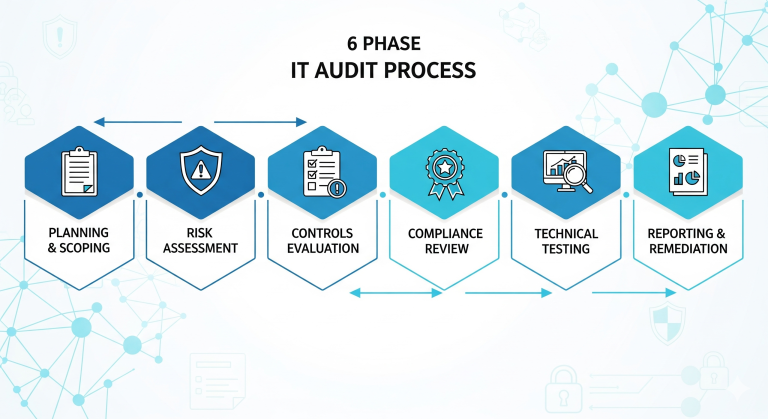
For organizations building internal capabilities, our complete IT audit checklist provides a structured approach to conducting comprehensive internal assessments. Understanding the cybersecurity audit process helps organizations prepare for either approach while setting realistic expectations.
Cost Comparison: Internal vs External IT Audit Investment
Cost considerations significantly influence audit approach decisions, but organizations must evaluate total investment beyond initial assessment fees.
Internal IT Audit Costs
Staff Time Allocation represents the largest cost component. Basic IT security assessments require 40-80 hours of dedicated effort, while comprehensive evaluations demand 120-200 hours. Organizations must account for staff time diverted from operational responsibilities.
Training and Certification Costs range from $2,000 to $5,000 annually per team member. Professional certifications like CISA, CISSP, or CISM require ongoing education and recertification fees.
Tool and Software Expenses typically cost $500 to $3,000 annually for vulnerability scanners, compliance tracking software, and audit management platforms.
External IT Audit Costs
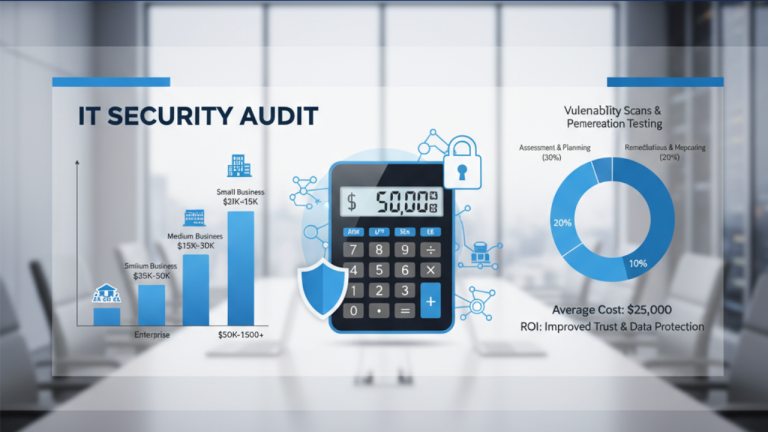
Small Business Investments (1-50 employees) typically range from $3,000 to $8,000 for basic IT security audits. Medium Business Investments (51-500 employees) generally cost $8,000 to $20,000 for comprehensive assessments. Enterprise Investments (500+ employees) range from $20,000 to $50,000+ for comprehensive security evaluations.
Hidden Costs include internal preparation time (20-40 hours), follow-up remediation, and potential need for additional consulting support.
For detailed pricing breakdowns, see our comprehensive IT security audit cost breakdown with real-world examples. Small businesses should also review our small business IT audit pricing guide for cost-effective strategies.
Internal IT Audits: Advantages, Limitations & When to Choose
Advantages
Ongoing Monitoring provides real-time visibility into security posture changes through quarterly or monthly assessments. Deep Organizational Knowledge enables internal auditors to understand business processes and operational constraints. Lower Per-Assessment Costs make internal audits attractive for frequent evaluations. Immediate Implementation accelerates security improvements since internal teams can begin remediation immediately.
Limitations
Potential Lack of Objectivity creates the most significant limitation—internal auditors may face pressure to minimize findings. Limited Specialized Expertise in emerging threats often constrains audit quality. Resource Constraints prevent many small organizations from developing effective capabilities. Conflicts of Interest arise when auditors evaluate systems they helped implement.
Best Use Cases
Internal audits work best for organizations with dedicated IT security teams, ongoing compliance monitoring needs, pre-assessment preparation for external audits, and budget-conscious environments requiring regular assessments.
External IT Audits: Benefits, Drawbacks & Optimal Scenarios
Advantages
Independent Perspective provides objective assessments without organizational bias. Specialized Expertise in latest threats and frameworks helps identify vulnerabilities internal teams might miss. Industry Benchmarking offers valuable insights into effective security practices. Regulatory Compliance Support often requires external validation. Stakeholder Credibility demonstrates due diligence to investors and customers.
Limitations
Higher Per-Assessment Costs make external audits expensive for frequent assessments. Limited Ongoing Context prevents understanding of organizational nuances. Business Disruption occurs when external auditors require extensive staff time. Less Frequent Cycles provide point-in-time snapshots rather than continuous monitoring.
Optimal Scenarios
External audits are essential for regulatory compliance requirements, customer assurance needs, post-incident validation, organizations lacking internal expertise, and annual comprehensive assessments.
Business Size Decision Framework
Small Business (1-50 employees)
Recommended Approach: External audits for comprehensive assessments with basic internal monitoring. Frequency: Annual external audit with quarterly internal checks. Budget: 2-5% of IT budget, with 70-80% for external audits.
Medium Business (51-500 employees)
Recommended Approach: Hybrid model combining internal monitoring with external validation. Frequency: Annual external audit with monthly internal assessments. Budget: 3-7% of IT budget, split 50-60% external, 40-50% internal capabilities.
Enterprise (500+ employees)
Recommended Approach: Robust internal program with external validation. Frequency: Continuous internal monitoring with annual external audits. Budget: 5-10% of IT budget, with 60-70% for internal programs.
Industry-Specific Considerations
Healthcare Industry
HIPAA compliance requirements mandate external validation for many organizations. Business associate agreements often specify independent assessments, and patient data sensitivity requires specialized expertise that external auditors provide.
Financial Services
SOX compliance often requires external validation, while PCI DSS requirements mandate external assessment for larger merchants. Multiple regulatory frameworks benefit from external expertise in overlapping requirements.
Technology/SaaS
SOC 2 Type II requirements mandate external audits for customer assurance. Rapid infrastructure changes require continuous internal monitoring complemented by external validation for stakeholder confidence.
Hybrid Approaches: Combining Both Strategies
Hybrid strategies optimize cost-effectiveness while maximizing security coverage. Staff Augmentation brings external experts into internal teams for specific projects. Phased Approaches coordinate quarterly internal assessments with annual external validation. Specialized External Support provides targeted expertise for cloud security, penetration testing, or compliance certification.
Best Practices include clear role definition, coordinated communication, and unified reporting that integrates findings from both internal and external assessments.
Implementation Guide
Assessment Phase
Evaluate organizational capabilities, compliance requirements, risk priorities, and budget constraints. Honest assessment of internal expertise and available resources guides approach selection.
Vendor Selection
For external audits, verify expertise and certifications, assess methodologies and tools, check references, and negotiate clear contracts with defined scope and deliverables.
Internal Development
Build capabilities through skills assessment, training programs, tool selection, and process documentation. Develop repeatable methodologies and integrate continuous improvement.
Success Metrics
Measure effectiveness through vulnerability reduction, compliance achievement, incident prevention, and stakeholder satisfaction. Regular program reviews ensure approaches remain effective as organizations grow.
ROI Analysis: Measuring Value
Risk Reduction
Data breach prevention provides the most significant ROI—with average breach costs exceeding $4.5 million, even expensive audits prove cost-effective. Organizations with regular audit programs experience 40-60% fewer security incidents.
Compliance Benefits
Regulatory fine prevention offers substantial returns. HIPAA violations can cost up to $1.5 million per incident, while GDPR penalties reach 4% of annual revenue. Customer requirement fulfillment enables business development and contract renewals.
Operational Improvements
Audit findings typically generate 15-30% efficiency improvements in IT operations. Technology investment optimization and streamlined processes provide measurable returns that justify audit investments.
Strategic Value
Market differentiation through security certifications, investor confidence building, M&A readiness, and insurance premium reductions create long-term business value beyond immediate security improvements.
Conclusion
The choice between internal and external IT audits should align with organizational size, compliance requirements, and security maturity. Small businesses typically benefit from external expertise they cannot develop cost-effectively. Medium organizations find hybrid approaches optimal, while enterprises can develop sophisticated internal programs with external validation.
Successful strategies often combine both approaches—internal audits for continuous monitoring and external audits for stakeholder assurance and specialized expertise. This balanced approach optimizes cost-effectiveness while maximizing security coverage and business value.
The evolving cybersecurity landscape makes regular assessments essential for business protection and stakeholder confidence. Whether choosing internal, external, or hybrid approaches, implement systematic programs that identify vulnerabilities, drive improvements, and demonstrate security maturity to customers, investors, and regulators.