
Picture this. You work at Clearwater Financial Services, a mid-size fintech. On Tuesday morning, a client sends your team a 40-page security questionnaire. They will not sign the contract until someone answers it. The questions look like this: “Do you have a documented access control policy?” “How often do you review user access?” “Who approves exceptions to your password standard?”
Nobody on the sales team can answer. The IT team is busy keeping systems running. So the questionnaire sits in an inbox for three weeks while a six-figure deal stalls.
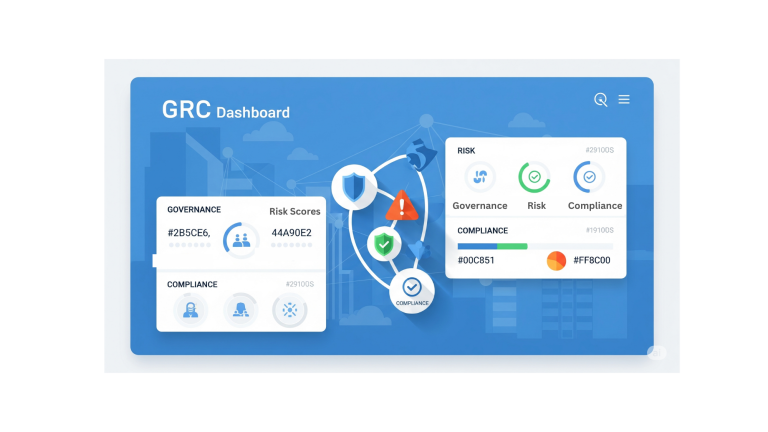
The person whose job it is to answer those questions, to make sure the answers are actually true, and to fix the gaps when they are not, works in GRC. That stands for governance, risk, and compliance. And here is the part most career guides skip: that person does not need to write code, configure firewalls, or hunt hackers. They need to understand how a business protects itself, prove it with evidence, and communicate it clearly.
If you can learn a structured way of thinking and back it up with practice, you can get into GRC without a technical background. I did it myself, moving from aviation security auditing into cybersecurity GRC in Canada, and I have watched career changers from HR, accounting, teaching, law, and healthcare do the same. This roadmap covers the full journey: what to learn, in what order, what proof employers want, and how long it honestly takes.
What GRC actually is (through a work situation, not a definition)
Go back to Clearwater for a moment. Here is what a GRC analyst actually does in a normal week there:
Governance is the rulebook. The analyst checks that Clearwater has written policies (like an access control policy) and that those policies match how the company really works. When the client questionnaire asks “do you have a documented policy,” governance work is what makes the answer “yes.”
Risk is the “what could go wrong” work. Clearwater stores customer banking data with a cloud provider. What happens if that provider has an outage? What if an employee falls for a phishing email? The analyst identifies these risks, estimates how likely and how damaging they are, and helps leadership decide which ones to fix first. Businesses cannot fix everything, so someone has to rank the problems.
Compliance is proving it. Clearwater must follow privacy laws like PIPEDA in Canada, and clients expect alignment with frameworks like NIST or ISO 27001. Compliance work means gathering evidence, screenshots, access review records, and training logs, that shows the rules are being followed. Auditors and clients do not accept “trust us.” They accept evidence.
Notice what is missing from that week: no coding, no server configuration, no incident response at 3 a.m. GRC is the business side of cybersecurity. It sits between technical teams and leadership, translating in both directions.
Why GRC is realistic without a technical background
GRC is one of the few cybersecurity paths where non-technical experience is often an advantage, not a gap to apologize for.
The demand data backs this up. CyberSeek, the workforce data project run by NIST’s NICE program, Lightcast, and CompTIA, tracked over 514,000 US cybersecurity job postings in its 2025 data release, and the calculated supply-demand ratio was 74 percent, meaning demand for talent still outruns supply. More interesting for you: when CyberSeek mapped those postings to the NICE Workforce Framework categories, Oversight and Governance was the single largest category, with more postings than Protection and Defense.
Governance work is not a niche corner of the field. It is the biggest slice of employer demand. (Validate current figures at cyberseek.org, as these update annually. Canadian readers can also check the Government of Canada’s cyber workforce reporting through ICTC and the Canadian Centre for Cyber Security for domestic demand signals.)
Why does GRC reward career changers specifically? Because the core skills are ones many professionals already have:
- Reading and interpreting rules. If you have ever applied a policy, a regulation, a contract clause, or a clinical protocol, you have done governance thinking.
- Weighing trade-offs. If you have ever decided what to prioritize with a limited budget or limited time, you have done risk thinking.
- Documenting and proving. If you have ever prepared for an inspection, an audit, a quality review, or a legal filing, you have done compliance thinking.
Technical staff often struggle with exactly these skills. Companies regularly have engineers who can configure anything but cannot write a policy a regulator would accept, or explain a risk to a CFO in two sentences. That gap is your opening.
The myth of “you need to code first”
You will hear this advice constantly: “learn networking, get Security+, learn Python, then think about GRC.” That path works, but it is not required, and for many career changers it wastes six months on material they will rarely use.
Here is the honest version. You do not need to code. You do need technical literacy: enough to hold a credible conversation. You should be able to explain, in plain words, what a firewall does, what multi-factor authentication is, why patching matters, and roughly how data moves between a user, an application, and a database. That is vocabulary, not engineering. You can build it in weeks, not years, and you will keep building it on the job.
The test I give my students: if a Clearwater engineer says “we can’t enforce MFA on that legacy app,” can you understand why that matters, ask a sensible follow-up question, and write the risk down accurately? That is the bar. Not writing scripts.
How to get into GRC with no experience: the 5-stage roadmap
This is the sequence I recommend, in order. Each stage builds the material for the next one.
Stage 1: Learn the language (risk, controls, compliance)
Time: 2 to 4 weeks.
Every profession has vocabulary, and interviews screen for it fast. Before frameworks or certifications, get fluent in the core terms:
- Asset: anything of value to the business (customer data, a payment system, a laptop).
- Threat: something that could cause harm (a phishing attacker, a flood, an insider mistake).
- Vulnerability: a weakness a threat can exploit (no MFA, an unpatched server, an untrained employee).
- Risk: the combination. How likely is the threat to exploit the vulnerability, and how bad would it be?
- Control: the thing you put in place to reduce the risk (MFA, backups, training, an approval process).
- Likelihood and impact: the two dials you use to rate every risk.
- Residual risk: what is left over after your controls. There is always something left over.
Practice by narrating everyday situations in this language. Your house is an asset. Burglary is a threat. An unlocked back door is a vulnerability. The deadbolt is a control. When this framing becomes automatic, you think like a GRC analyst.
Free sources for this stage: the glossary sections of NIST publications at csrc.nist.gov, and ISACA’s free career and terminology resources at isaca.org.
Stage 2: Learn one framework properly (NIST CSF 2.0)
Time: 3 to 5 weeks.
Beginners often sample five frameworks and master none. Do the opposite. Learn one deeply, and make it NIST Cybersecurity Framework 2.0, published by NIST in February 2024. It is free, it is the most widely referenced framework in North American job postings, and its structure teaches you how all frameworks work.
CSF 2.0 organizes cybersecurity into six functions: Govern, Identify, Protect, Detect, Respond, and Recover. The Govern function is new in 2.0, and its addition tells you something important: the industry formally recognized that governance is central, not optional. Under each function sit categories and subcategories that describe outcomes, like “access to assets is limited to authorized users.”
Do not just read it. Work it. Take Clearwater Financial Services (or any imaginary company you invent) and walk through each function asking: what would this company need to have in place? What evidence would prove it? Write your answers down. That written walkthrough becomes raw material for Stage 4.
Once CSF 2.0 feels solid, skim ISO 27001 and, if you are targeting Canadian financial services, OSFI Guideline B-13. You will find they rhyme. Frameworks differ in structure and enforcement, but the underlying logic, identify what matters, protect it, prove it, is the same everywhere.
Stage 3: Do the work before the job (practice assessments)
Time: 4 to 6 weeks.
This is the stage most career changers skip, and it is the one that changes interviews the most. You cannot get GRC experience without a job, but you can do GRC work without one. The tasks are documents and judgment, not production systems, so nothing stops you from practicing.
Three exercises, all using your fictional company:
- A gap assessment. Take 10 to 15 CSF 2.0 subcategories and assess Clearwater against them. For each one, state whether the control exists, partially exists, or is missing, and what evidence you would ask for. Invent realistic details: maybe Clearwater has MFA for email but not for its admin accounts.
- A risk register. Identify 8 to 10 risks for Clearwater. Rate each for likelihood and impact on a simple scale. Rank them. Recommend one treatment for each: fix it, accept it, transfer it (insurance), or avoid the activity.
- One policy document. Write a short access control policy for Clearwater. One to two pages. Purpose, scope, rules, exceptions, review cycle.
These three artifacts force you to make the exact judgment calls the job requires. When an interviewer asks “walk me through how you would assess a control,” you will not recite a definition. You will describe something you have actually done.
Working through these exercises and want structure? My free GRC Starter Kit includes the templates I use for exactly these three artifacts: a gap assessment worksheet, a risk register template, and a policy skeleton, plus the Transferable Skills Inventory from later in this article. [Download the GRC Starter Kit here.]
Stage 4: Build evidence (portfolio projects)
Time: 2 to 4 weeks, mostly polishing Stage 3 output.
Employers hiring entry-level GRC candidates face a wall of resumes that all say “detail-oriented” and “fast learner.” Proof cuts through. Your Stage 3 work becomes your portfolio:
- Clean up the three artifacts so a stranger could read them. Add a short cover note to each explaining the scenario and your reasoning.
- Host them somewhere linkable: a simple Google Drive folder, a Notion page, or a basic personal site.
- Add one summary document: “Sample GRC Assessment: Clearwater Financial Services (fictional),” describing what you did and what you found. Always label the scenario as fictional. That is itself a demonstration of integrity, which is the currency of this profession.
- Optional but powerful: record a 5-minute video walking through your risk register. Communication is half the job, and almost no entry-level candidate demonstrates it.
Certifications fit here too, as a supplement rather than a substitute. For true beginners, ISACA’s entry-level credentials or CompTIA Security+ signal commitment. But a certification says “I studied.” A portfolio says “I can do the work.” Hiring managers weight the second more than the internet suggests.
Stage 5: Target the right entry roles
Time: ongoing, typically 2 to 4 months of active searching.
“GRC Analyst” is not the only door in, and often not the easiest one. Search for these titles too:
- Compliance analyst / compliance coordinator (especially in banks, insurers, and healthcare)
- IT audit associate (accounting and consulting firms hire cohorts of these and train them)
- Third-party risk analyst / vendor risk analyst (a huge growth area, and questionnaire-heavy work suits strong writers)
- Privacy analyst (a natural fit if your background touches legal, HR, or records management)
- Security awareness coordinator (a fit for people from training, education, or communications)
- Business continuity coordinator
Two targeting tips. First, industries that are already regulated, financial services, insurance, healthcare, government, energy, hire more GRC people and are more comfortable training them, because compliance is not optional there. Second, mid-size organizations often beat both tiny companies (no dedicated GRC role) and giant ones (rigid experience requirements) for a first role.
When you apply, connect your old career to the new one explicitly. Do not make the recruiter do the translation. Which brings us to the inventory exercise below.
Timeline expectations (honest, not hype)
You have seen the ads promising a six-figure GRC job in 90 days. Here is what I actually see, and what the numbers above about a competitive entry-level market support:
- Months 1 to 3: Stages 1 and 2. Language and framework, studying part-time around a job and a life.
- Months 3 to 5: Stages 3 and 4. Practice work and portfolio.
- Months 4 to 9: Stage 5 overlapping with the rest. Applications, networking, interviews.
A realistic total: 6 to 12 months from a standing start to a first offer, part-time. Some people land sooner, usually because their current job already touches audit, quality, legal, or regulated operations, which shortens the translation. Some take longer, usually because of local market conditions or a stop-start study rhythm rather than any lack of ability.
Also be honest with yourself about the first salary. Entry-level GRC pays a professional salary, but the strong numbers you see quoted are usually mid-career figures. The pattern that repeats: the first role is the hard one to get. The second one, 18 to 24 months later, comes with real leverage.
Your transferable skills inventory
This is the exercise I assign before anyone writes a resume. It takes 20 minutes and changes how you present yourself.
Step 1. List five tasks you actually do in your current or most recent job. Be specific. Not “communication,” but “prepared monthly variance reports for the regional manager.”
Step 2. For each task, ask: is this governance (rules and structure), risk (judging what could go wrong and what matters most), or compliance (evidence, checking, proving)? Most professional tasks map to at least one.
Step 3. Rewrite each task in GRC language.
Examples from real career changers:
| Current-job task | GRC translation |
|---|---|
| HR: investigated policy violations and documented outcomes | Conducted control-violation investigations and maintained audit-ready records |
| Accounting: reconciled accounts and flagged discrepancies | Performed detective control activities and escalated exceptions |
| Teaching: adapted curriculum to provincial standards | Mapped internal practices to an external framework and closed gaps |
| Retail management: ran health-and-safety checklists before opening | Executed recurring compliance checks and tracked remediation |
| Nursing: followed medication verification protocols | Applied segregation-of-duties and verification controls in a high-risk process |
Do this for your own five tasks and you have the spine of your resume, your LinkedIn summary, and your answer to “why should we hire someone without security experience?” The full worksheet version of this exercise is included in the Starter Kit.
Common mistakes that stall career changers
I see the same five patterns stall smart people:
1. Collecting certifications instead of doing work. Three certs and no portfolio reads as theory. One cert and three work samples reads as capability. If you have already started cert-stacking, stop, do Stage 3, then resume if a specific job posting demands it.
2. Studying forever and applying never. There is no moment when you will feel ready. Apply when you can explain a risk register you built. Interviews are training data. Your fifth interview will be dramatically better than your first, so start collecting them early.
3. Hiding the previous career. Career changers often strip their history down to nothing, afraid it looks irrelevant. It is the opposite. Your years of professional judgment are the differentiator against 22-year-old graduates. Translate the experience (see the inventory above), never bury it.
4. Learning tools before concepts. Do not start with ServiceNow GRC, Vanta, or any platform. Tools change and companies train you on theirs. The concepts, risk, controls, evidence, are permanent. Concepts first, always.
5. Applying only to jobs titled “GRC Analyst.” You will miss most of the market. Revisit the six alternative titles in Stage 5 and search those weekly.
Next step
Here is the roadmap in one paragraph. Learn the language of risk and controls. Go deep on NIST CSF 2.0 and understand why the Govern function exists. Do three pieces of practice work on a fictional company before anyone pays you to. Package that work as proof. Then target the full range of entry titles in regulated industries, with your old career translated, not hidden. Six to twelve months of honest part-time effort. No code required.
If you want to start today, download the free GRC Starter Kit. It contains the gap assessment worksheet, risk register template, policy skeleton, and the Transferable Skills Inventory, everything you need to complete Stages 1 through 4 on your own. [Get the GRC Starter Kit.]
And if you want the guided version, the GRC Accelerator is my 12-week program that walks career changers through this exact roadmap with live teaching, feedback on your portfolio work, and a Canadian-market focus, including the regulations Canadian employers actually ask about, like PIPEDA, Law 25, and OSFI B-13. You bring the professional experience you already have. I will help you translate it.
You answered harder questions in your last career than “what is a control?” This one is learnable. Start with Stage 1 this week.
If you want to go deeper on the regulatory side The Complete Guide to GRC Compliance in Canada is a good next-step read.